
In the early 1950s, the dairy trade in Anand ran on a simple, comfortable theory: farmers produced too little milk, and what little they produced spoiled before reaching the cities. Contractors controlled the routes, fixed the prices, and nobody questioned the story, because nobody who wrote it had ever milked a buffalo. Verghese Kurien went to the villages instead. What he found had nothing to do with supply. Farmers were being paid a fraction of what their milk was worth, and the system had no incentive to notice. The cooperative he built on that discovery became Amul. The theory didn’t need patching. It needed to be checked against the ground.
“The problem is my CTO,” the CEO told me, without hesitation.
“The real problem is the CEO,” the COO told me, just as certain.
I spent the next three days with their team. By the end of the week, one thing was obvious. Neither of them was right. Both were reading the trade’s theory. Neither had been to the village.
Not The Boardroom First
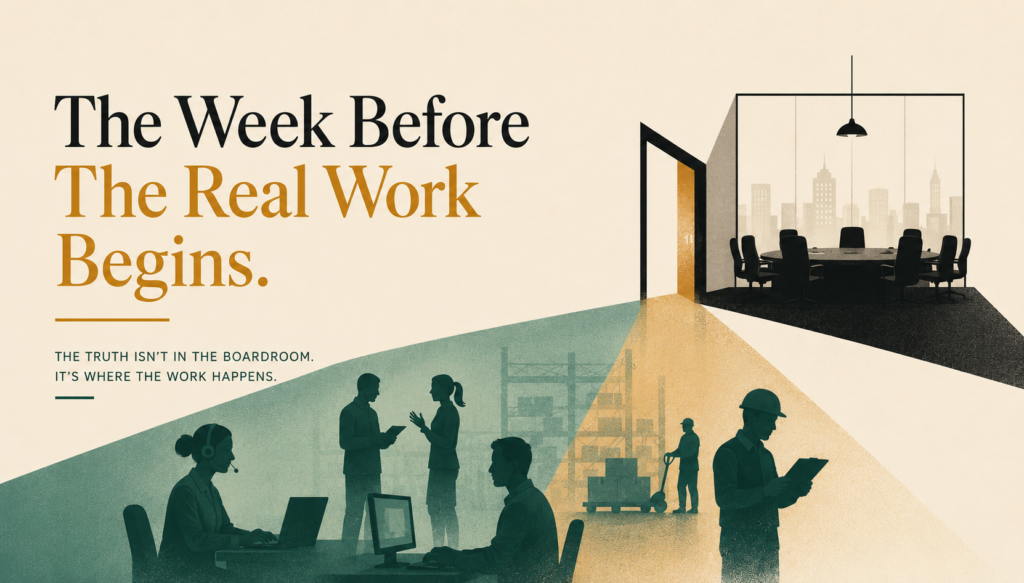
Most people assume week one of a transformation engagement is leadership interviews, dashboard reviews, strategy decks. I can sense the logic in that assumption; those conversations are efficient, they’re scheduled, they produce minutes. But they only tell you how a business believes it operates. To learn how it actually operates, you have to go where the milk is actually collected.
So I spend as much time outside the boardroom in week one as inside it.
Where The Truth Actually Sits

I sit with the person answering customer calls. I watch the salesperson who has quietly learned which approvals are worth chasing and which ones are theatre. I talk to the executive keying data into the ERP all day, not because I need a software tutorial, but because they know exactly where the process fractures. I stand on the shop floor next to someone trying to calm an angry customer because billing took twenty minutes instead of two. Procurement, warehouse staff, dispatch, finance, middle managers, the people who’ve quietly built workarounds just to keep the business breathing despite its own systems.
A Promise, Before Anything Else
Before any of these conversations start, I make one promise. What they tell me stays between us. I am not building a case against anyone. I’m trying to understand why capable people are struggling inside a system they inherited, not designed.
Something reliable happens once people believe that promise. They stop giving corporate answers. They tell you which report nobody reads. Which approval exists because of a mistake made five years ago that nobody’s questioned since. Which metric everyone nods at in the monthly review and nobody actually believes. Which process the whole team bypasses because doing it properly would make the work impossible.
None of this shows up on a dashboard. All of it shapes the business, every single day, the way the real economics of milk collection shaped Anand long before anyone in the trade thought to ask a farmer directly.
What Week One Actually Reveals
By the end of week one, the picture is rarely flattering. The CEO realizes the technology problem is actually a decision rights problem. The COO discovers operations aren’t slow because people lack capability, but because the organization has unintentionally optimized for control over speed. Middle managers realize they’re carrying responsibility without the authority to discharge it. Teams discover they’ve been solving the same problem in parallel for years because nobody connected the dots between them.
It’s rarely what people expect to hear. It’s almost always what they need to see.
You cannot fix a business on the strength of a theory. You can only fix what you’ve actually traced back to its source, and that source is never in the deck. It’s in the daily, unglamorous experience of the people keeping the business running.
That’s why I don’t call the first week a discovery phase anymore. I call it an inflection point. The moment stories give way to evidence. Opinions give way to patterns. Blame gives way to understanding.
It’s rarely comfortable. In every transformation I’ve been part of, it’s been the moment that made everything else possible.
Sometimes the fix isn’t a better theory. It’s the discipline to go and sit with the farmer.