
Introduction
Building on our previous discussion on decision-making under uncertainty, this article introduces the The Catalyst Framework—Explore, Engage, and Execute—a structured, data-driven methodology that enables organizations to navigate volatile business landscapes. This framework integrates key business pillars: People, Process, Product/Service, and Technology, ensuring a holistic approach to decision-making.
In my two decades as a strategy and operations consultant, I’ve witnessed countless businesses face what I call inflection points—critical moments where decisions can either propel an organization to new heights or lead to stagnation. In today’s highly volatile business world, customer expectations are constantly evolving, and operational inefficiencies can quickly erode profitability.
Consider the hospitality sector, for example. The rise of online travel platforms, the demand for personalized experiences, and the need for seamless digital interactions have forced hotels, restaurants, and other service-based businesses to rethink their strategies. Those that adapt thrive; those that don’t risk falling behind.
Over the years, I’ve developed a strategic approach to help businesses navigate these inflection points with confidence. I call it The Catalyst Framework, and it’s built on three core phases: Explore, Engage, and Execute. This framework has been instrumental in transforming organizations across industries, where the interplay between people, processes, product/service and technology is critical. In this article, I’ll walk you through how I apply The Catalyst Framework with an example of a boutique hotel to transform its guest experience and operational efficiency. Along the way, I’ll share insights that can be applied to any service-based business facing similar challenges.
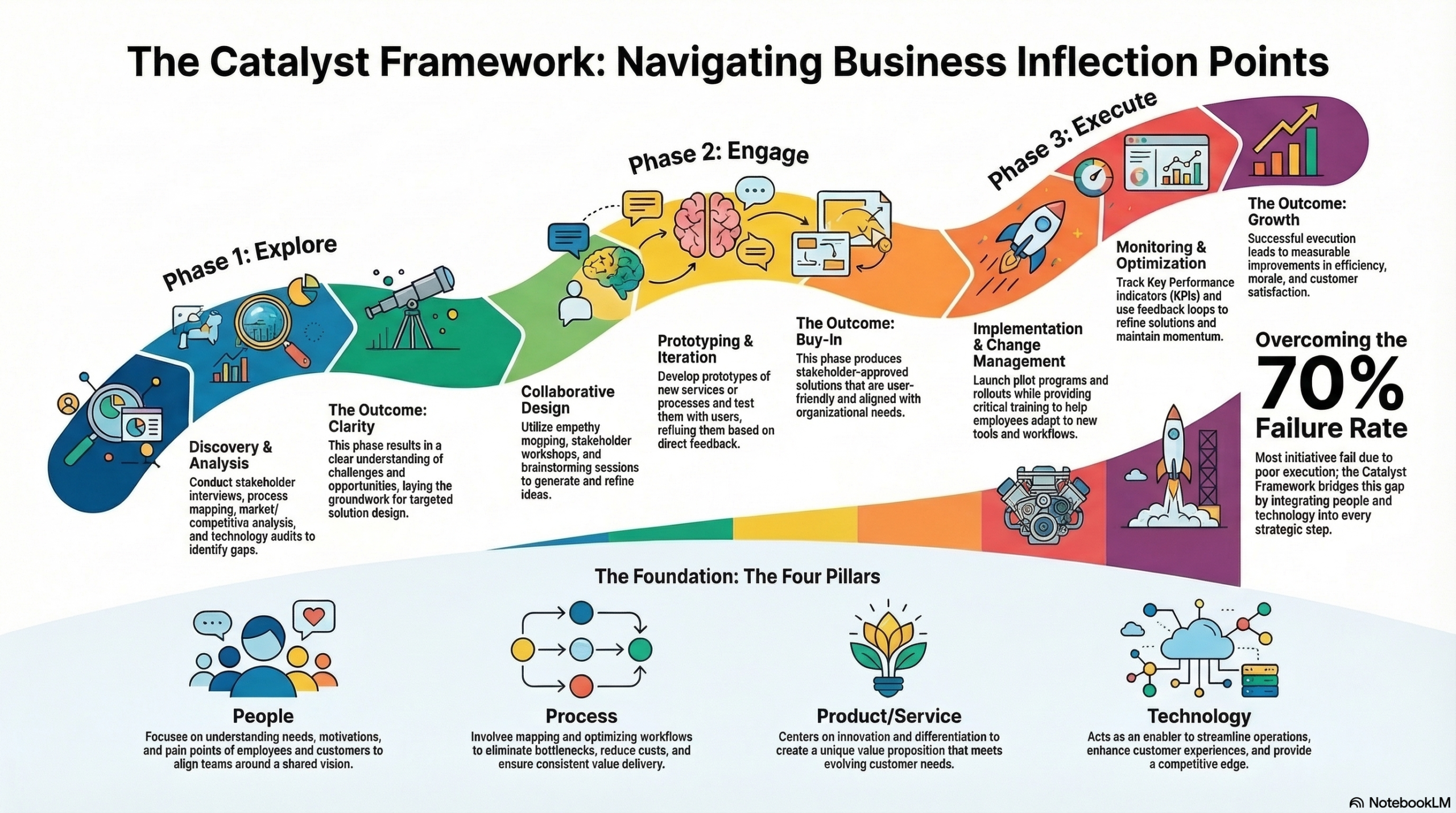
1. Explore: Uncovering the Root of the Challenge
Every successful transformation begins with a deep understanding of the current state. The Explore phase is about identifying the needs, challenges, and expectations of stakeholders across all levels of the organization. This phase is critical because it lays the foundation for all subsequent actions.
- Understanding the People
- When I first engaged with the boutique hotel, it was clear that the staff was overwhelmed. Front-desk employees were juggling multiple tasks, from check-ins to handling guest complaints, while housekeeping teams struggled to keep up with room turnovers. Through interviews and surveys, I discovered that the staff felt undervalued and unsupported, which was impacting their ability to deliver exceptional service. On the guest side, feedback revealed frustration with long wait times, lack of personalization, and outdated technology. Guests wanted the convenience of mobile check-ins, personalized recommendations, and seamless communication with staff—features that were already being offered by larger hotel chains and online platforms.
- Assessing the Product/Service Offering
- Market research and competitive analysis revealed that the hotel was falling behind in several key areas. Competitors were leveraging technology to enhance the guest experience, offering mobile apps, loyalty programs, and personalized services. Meanwhile, our client’s offerings felt generic and outdated. The lack of differentiation was causing them to lose market share to more innovative competitors.
- Mapping the Processes
- Process mapping uncovered significant inefficiencies in the hotel’s operations. For example, the check-in/check-out process was manual and time-consuming, leading to long wait times for guests. Housekeeping schedules were not aligned with guest preferences, resulting in delays and frustration. Room service orders were often mishandled due to poor communication between departments.
- Evaluating the Technology
- The hotel’s property management system (PMS) was outdated and not integrated with other tools, such as customer relationship management (CRM) software or mobile apps. This lack of integration led to redundant data entry, errors, and missed opportunities to personalize the guest experience.
2. Engage: Co-Creating Solutions with Stakeholders
With a clear understanding of the challenges, we moved to the Engage phase, where we collaborated with stakeholders to co-create solutions that were both innovative and practical. This phase is rooted in the belief that the best solutions come from the people who are closest to the problem.
- Co-Creating with People
- We conducted a series of workshops with front-desk staff, housekeeping teams, and management to design new workflows that reduced manual tasks and improved guest interactions. Empathy mapping helped us understand the pain points of both staff and guests, leading to the development of a personalized service model. For example, we introduced a system where guests could specify their room preferences (e.g., early check-in, extra towels) during the booking process, allowing staff to prepare in advance.
- Prototyping New Products and Services
- Based on guest feedback, we prototyped a mobile app that allowed guests to check in/out, request services, and receive personalized recommendations based on their preferences. We also piloted a loyalty program to encourage repeat bookings. User testing sessions with guests helped us refine the app’s features and ensure it met their needs.
- Redesigning Processes
- We redesigned the housekeeping and room service processes to align with guest preferences and real-time data from the mobile app. For example, housekeeping schedules were optimized based on guest check-out times, and room service orders were tracked digitally to ensure accuracy and speed. Iterative testing with staff ensured the new workflows were efficient and guest-friendly.
- Developing Technological Solutions
- We worked closely with the hotel’s IT team to integrate the PMS with the new mobile app and CRM system. This integration allowed staff to access guest preferences and history in real time, enabling them to deliver personalized service. For example, if a guest had previously requested a late check-out, the system would automatically flag this preference for future stays.
3. Execute: Turning Strategy into Action
- Training and Change Management
- We rolled out comprehensive training programs for staff on the new workflows and digital tools. Change management initiatives, such as town halls and one-on-one coaching, helped ease the transition and address any concerns. Ongoing support was provided to ensure staff felt confident using the new systems.
- Launching New Products and Services
- The mobile app and loyalty program were launched hotel-wide. We monitored usage and gathered guest feedback to make continuous improvements. For example, based on guest input, we added a feature that allowed guests to order room service directly through the app.
- Implementing Optimized Processes
- The new housekeeping and room service processes were implemented with clear guidelines and KPIs. Regular reviews ensured the processes remained efficient and aligned with guest expectations. For example, we tracked metrics such as room turnover time and guest satisfaction scores to identify areas for further improvement.
- Deploying Technology Solutions
- The integrated PMS and mobile app were deployed across the hotel. Ongoing support and updates were provided to ensure the systems ran smoothly. For example, we worked with the IT team to address any technical issues and ensure the app was compatible with different devices.
Results: A Transformed Hotel
Within six months, the hotel saw significant improvements:
- Staff morale improved, with employees reporting feeling more empowered and less stressed.
- Guest satisfaction scores increased by 25%, driven by personalized service and seamless digital interactions.
- Repeat bookings rose by 20% due to the loyalty program and enhanced guest experience.
- Operational costs decreased by 15% as a result of streamlined processes and reduced manual tasks.
Conclusion: The Catalyst Framework in Action
In the service industry—where customer expectations are constantly rising—inflection points are inevitable. The question is not whether they will occur, but how you will respond. The Catalyst Framework provides a roadmap for navigating these moments with confidence, turning challenges into opportunities for growth and innovation.
As a consultant with over two decades of experience, I’ve seen firsthand how this framework can drive transformation across industries. Whether you’re running a hotel, a restaurant, or any other business, the principles of The Catalyst Framework can help you navigate your own inflection points and emerge stronger on the other side.
If your organization is facing an inflection point and you’re ready to transform challenges into opportunities, I invite you to reach out to me <Click Here> or connect with me on LinkedIn. Let’s explore how The Catalyst Framework can help you drive meaningful change and achieve sustainable growth. Together, we can co-create solutions that align with your unique needs and aspirations.