

It’s the question I get asked most often. If the transformations work, why don’t I just stay on as COO?
It’s fair. I’ve been asked to stay, more than once. I take it as a genuine privilege.
But the honest answer is: staying would mean I’d built scaffolding, not a foundation.
Why the distinction matters
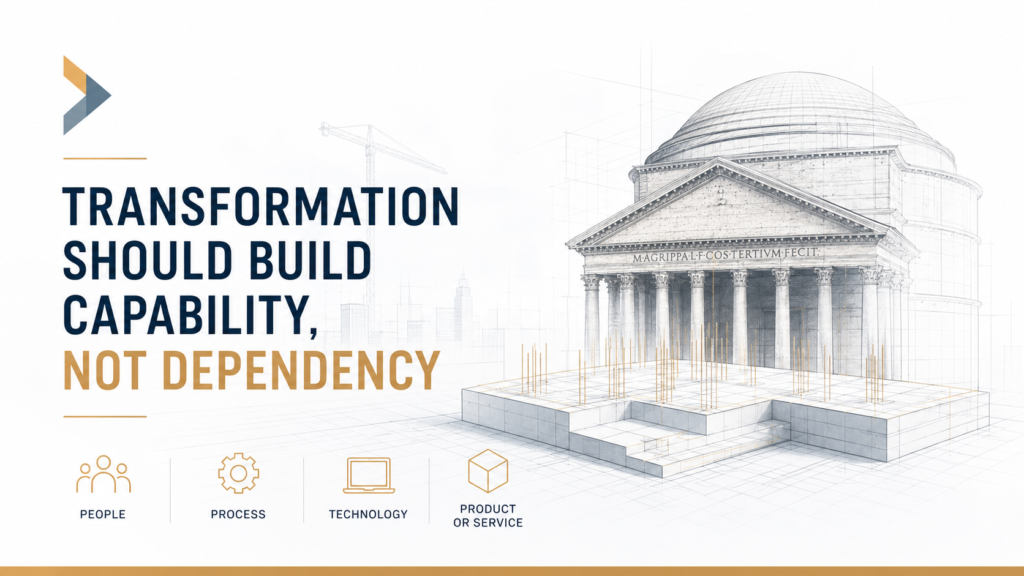
The Pantheon in Rome has held up its own dome for nearly two thousand years. No steel, no engineers on retainer. Whatever keeps it standing was decided once, before a single wall went up, and buried where no one would ever see it again.
That’s what a real transformation should look like. Not something that needs me standing next to it.
Organizations don’t have performance problems, they have foundation problems
Revenue plateaus. Margins shrink. Execution turns inconsistent. Most businesses treat these as separate fires. They’re not. They’re symptoms of what’s underneath — how leadership decides, how work actually flows, what gets measured and rewarded.
Replace the leader, install the new ERP, hire the consultants — if the foundation underneath hasn’t changed, the cracks travel upward again. That’s why so many transformation programmes lose momentum the week the project team leaves. The project ended. The foundation was never touched.
Transformation is foundation work
Technology comes after process. Process comes after a deep understanding of how the business actually runs — the real, messy workflow, not the idealised version on a slide. Leadership alignment comes before restructuring. Governance comes before dashboards.
This is the logic behind the Catalyst Framework — people, process, technology, and product or service, engineered together as one foundation, not four separate workstreams.
A foundation isn’t finished, it’s tested by what gets built on it next
No one pours a foundation for the building as it exists on day one. They pour it for the floors that haven’t been added yet.
That’s what people misunderstand about my leaving. It doesn’t mean the change stops. It means the mindset has shifted from something I was carrying to something the organization now carries itself.
I won’t pretend this always holds perfectly. People leave. Priorities shift with a new leader. Sometimes the very people I trained to carry the change move on, and someone else has to pick it up cold. I can’t engineer around that the way an actual foundation can be engineered around soil conditions.
What I can do is build it strong enough that it doesn’t depend on any one person staying, including me. That’s the aim.
Knowing when the foundation is ready
So when someone asks why I don’t stay on as CEO: the moment they’re asking is usually the moment my work is already at the point where it no longer needs me watching over it. Not finished. Just strong enough to keep building on.
The engineers who built the Pantheon’s foundation never got their names on it. That was rather the point.