

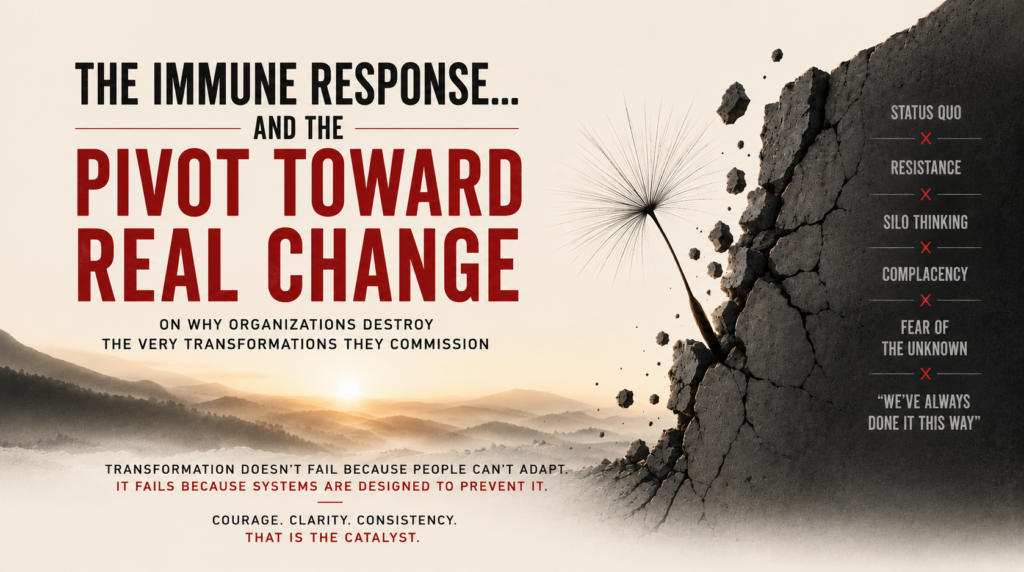
On why organizations destroy the very transformations they commission
Consider what happens when a surgeon gives someone a new heart.
The operation succeeds. The heart is healthy, perfectly sized, beating with purpose. And then the body begins to reject it, quietly, methodically, without malice. The immune system does precisely what it was designed to do: identify foreign intrusion and eliminate it.
This is not a malfunction. This is the system working perfectly.
It is also the most honest description of organizational transformation failure I have encountered. We have spent decades diagnosing the 70% collapse rate. We have built frameworks, coined phrases, appointed consultants. But the truth we keep sidestepping is this: organizations are not broken when they reject change. They are succeeding, exactly as designed, at preserving the current state.
The question is not how to force a transplant. The question is whether a leader has the courage to become the immunosuppressant.
The Adaptation Paradox
Humans are the most adaptable organisms on earth. From first steps to professional mastery, we are biologically engineered to evolve. Adaptation is not our exception; it is our standard.
And yet over 70% of organizational transformations collapse.
This is not a paradox about human nature. It is a design truth we resist accepting: we build organizations to be stable, then express puzzlement when they are. Every process, hierarchy, incentive, and norm is a deliberate act of stability engineering. Change fails not because people can’t adapt, but because the system they inhabit was architectured to prevent it.
The gap between strategic intent and systemic execution is not bridged by a mandate. It requires something rarer: a Catalyst. Someone willing to act against the very stability that granted them authority, on behalf of a future the organization cannot yet see.
Episodic Collapse of Transformation
Failure does not arrive with a bang. It unfolds in five quiet stages, each disguised as progress, each slightly harder to reverse than the last.
Episode 1: The Announcement Surge. The vision is declared. Energy is real. Alignment appears universal. But the trap is already set: agreement on the idea of change is mistaken for agreement on its implications. One is cheap. The other is expensive. The organization has signed up for the destination without understanding the cost of the journey.
Episode 2: Structural Friction. Vision meets the actual organization. Every governance structure, incentive, and informal power arrangement reveals itself as a mechanism designed to perpetuate the current state. The transformation doesn’t fail here; it simply surfaces the truth that the organization was built to maintain the very stability it now needs to disrupt.
Episode 3: Behavioral Regression. Old spreadsheets reappear alongside the new system. Shadow approval channels emerge to “keep things moving.” This is not sabotage; it is survival. The human brain, confronted with the unknown, retreats to the metabolic efficiency of the familiar. Without a compelling reason to endure the discomfort of the new, the old will always win.
Episode 4: The Courage Gap. Friction finally reaches the leadership table. The structural contradictions, siloed incentives, legacy power arrangements, governance that rewards caution while strategy demands speed, require a decision. Most leaders choose accommodation over confrontation. They grant exceptions. They extend timelines without addressing root causes. Each compromise feels reasonable in isolation. Together, they signal to the organization that the Old Way still has a viable future. With that signal, the transformation’s fate is sealed.
Episode 5: Transformation Theatre. Dashboards stay green. Steering committees meet religiously. The system has learned to simulate progress while remaining unchanged. It has not rejected the transformation noisily; it has absorbed it without being reshaped by it. The immune response has won, and no one in the room will say so.
The Catalyst
In chemistry, a catalyst lowers the activation energy required for a reaction to occur; it doesn’t create the energy, it removes the friction preventing the reaction. In a business transformation, a Catalyst is anyone who does the same: removes friction, accelerates alignment, and holds the system accountable to the change it committed to.
Three types operate at different levels.
The Executive Catalyst is the CEO or MD, the non-negotiable one. Without the top leader’s personal stake in the outcome, the organization treats the transformation as a disruption to be waited out. This catalyst provides the courage to face structural contradictions and the conviction to hold the line.
The Agent Catalyst, internal or external, provides infrastructure: the process architecture, the cadence of oversight, the objective reality check that leadership, deep in the trenches, loses sight of. They don’t do the transformation; they make it possible.
The Cultural Catalyst is the high-performer and respected mid-level manager who embodies the new way visibly. When empowered, they shift the social proof of the organization, moving change from a top-down mandate to a peer-led movement.
The Courage Imperative
A Catalyst-Leader is defined not by position but by willingness to make themselves personally uncomfortable in service of the change they are asking others to absorb. You cannot mandate a behaviour you do not practice. Three responsibilities directly counter the anatomy of failure.
Build the ‘why’ deep enough to survive the middle. Every transformation has a meaningful beginning, a meaningful end, and a long grinding middle where nothing appears to be working. The ‘why’ is the only thing that carries people through it; not the strategy deck, not the dashboard. A strong ‘why’ does not say we need to be better. It makes the status quo feel more dangerous than the uncertainty ahead.
Confront rather than accommodate. The most consequential act of courage in any transformation is the willingness to hold the structural contradiction in the room, the misaligned incentive, the legacy power arrangement, the governance process that contradicts the new operating model, and refuse to leave with an exception. Every exception is a signal. The organization reads every signal.
Make transformation the main business, not a side project. A leader who attends to transformation between quarterly reviews has already communicated its relative importance. The organization will respond accordingly. A catalyst must be present in the reaction for it to occur. In transformation, presence is not a metaphor; it is a prerequisite.
Five Questions to Answer Before Jumping Off the Cliff of Transformation
Even the most courageous leader cannot catalyze what the ground conditions won’t support. Before the first announcement, sit honestly with these.
1. Is the top leader personally committed, not just organizationally committed? An organization senses the difference between a leader who owns a transformation and one who has appointed it. If the CEO treats this as someone else’s responsibility, the system will treat it as a disruption to be waited out.
2. Is the ambition set high enough to require genuine behavioral change? If the goal can be achieved without fundamentally altering how people work, it is optimization, not transformation. Optimization is valuable, but do not call it transformation. The gap between the two is precisely where organizations lose credibility with themselves.
3. Are the best people leading it, not the available ones? The right test: if moving someone to the transformation doesn’t hurt the daily business, you haven’t moved the right person.
4. Is there genuine trust in the process, including the findings that will implicate leadership? The discovery phase will surface things leaders did not want to know. The question is whether there is courage to let those findings change the plan, rather than accommodate them into the existing one.
5. Is the organization benchmarking against external excellence, or against its own past? Grading on a curve is the most sophisticated form of transformation theatre there is.
What We Are Really Asking
In 1847, Ignaz Semmelweis discovered that doctors were killing their patients.
Working in a Viennese maternity ward, he noticed mortality rates in physician-staffed wards were dramatically higher than midwife-staffed ones. Physicians came directly from performing autopsies. His conclusion: invisible particles on unwashed hands were transmitting death. His solution: wash with chlorinated lime. Mortality in his ward fell 90%.
The Viennese medical establishment ended his career. His hypothesis implied that doctors, the most educated men in the hospital, were the agents of death. Semmelweis died in 1865 in a mental asylum, at 47, likely from the same infection he had spent his life trying to prevent. Fourteen years later, Pasteur confirmed germ theory. Handwashing became standard.
Semmelweis had the data. He had the answer. He had demonstrated results.
The system neutralized him completely.
He is not a story about individual failure. He is a story about the organizational immune response doing exactly what it was built to do. The doctors were not evil. They were not stupid. They were the immune system, protecting the current state against a foreign idea, at any cost.
The Courage Imperative is simply this: deciding, privately, before any announcement is made, which side of that equation you are willing to be on.
The path from stagnation to transformation does not begin with a framework. It begins with that decision. Everything else is implementation.
The Catalyst Framework — Explore, Engage, Execute — is the structured methodology that operationalizes the principles above.